
TOPCon vs HJT: which to buy in 2026?
Both are N-type technologies, both ship from the same factory, and both are warrantied for 30 years. The difference is where they perform best: TOPCon wins on efficiency per dollar, HJT wins in heat. Here is the datasheet-level comparison for your 2026 buying decision.
By EMS-SOLAR Engineering · Published 15 Aug 2026 · 8 min read
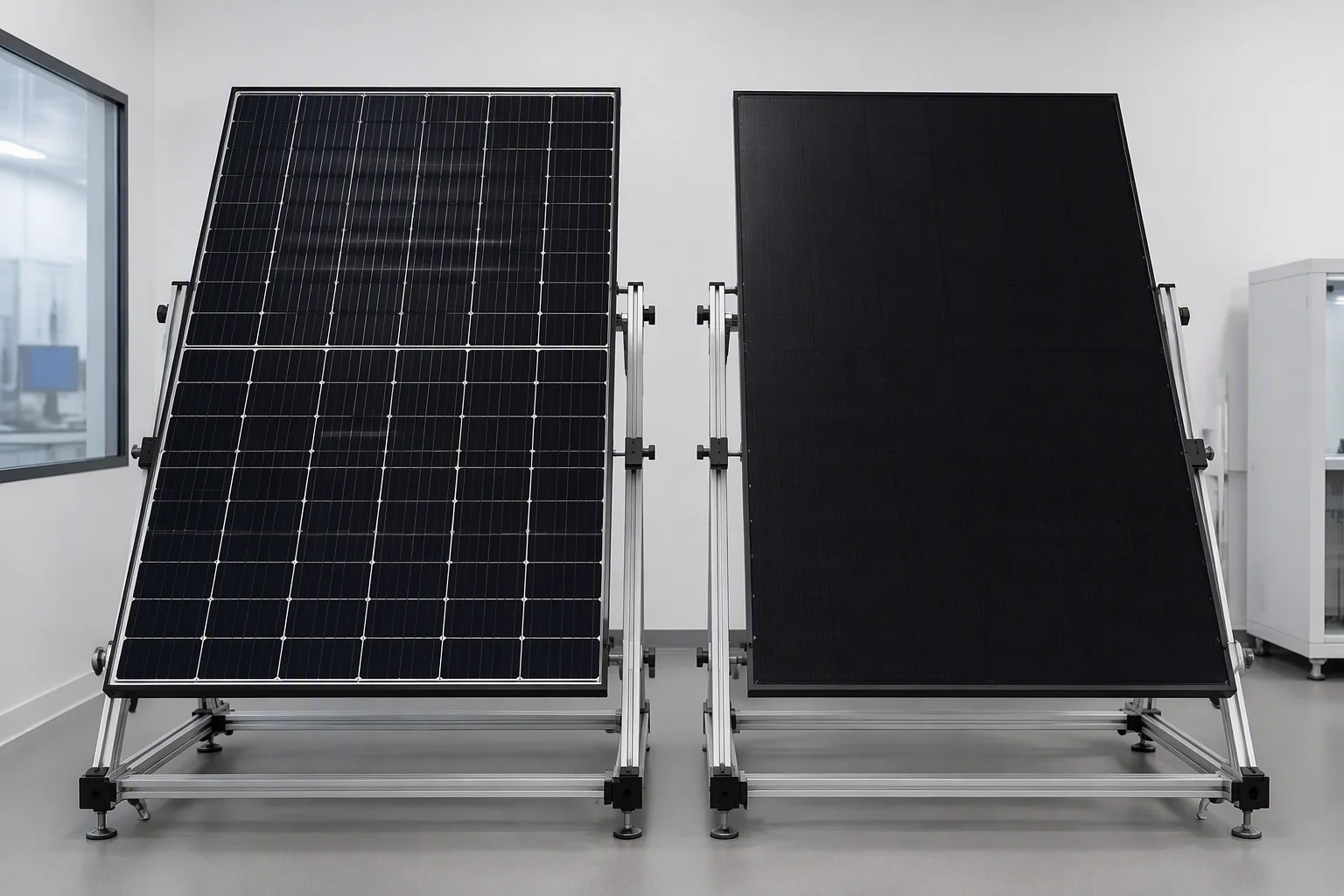
Global module shipments reached 536 GW in 2025, and two N-type architectures now dominate new capacity: tunnel oxide passivated contact (TOPCon) and heterojunction (HJT). The two share a lot — both start from N-type silicon, both are available as bifacial dual-glass modules, and both carry the same 15-year product / 30-year power warranty. The purchase decision therefore comes down to a handful of measurable differences: efficiency, temperature behaviour, bifaciality, price and availability. This guide walks through each one with the numbers, then closes with a decision table you can take into an RFQ.
Two N-type champions, one market
TOPCon is the volume technology of 2025–2026. It uses an ultra-thin tunnel oxide and a polysilicon layer on the rear side to passivate the contact, lifting efficiency without the expensive process steps of HJT. TOPCon modules dominate utility and rooftop supply, and the 536 GW shipped globally in 2025 was largely built on it. HJT, by contrast, stacks thin amorphous silicon layers on both faces of the N-type wafer. It costs more to make but delivers the lowest temperature coefficient in the market, which is why it keeps winning premium, hot-climate projects despite a smaller share of total volume.
Efficiency and power output
At module level, TOPCon holds the headline: commercial TOPCon modules reach up to 24.8% efficiency, and the flagship 620 W-class series spans 22.3–23.5% at 2278×1134 mm. HJT is close behind: 700 W-class dual-glass modules reach up to 23.66%, with rooftop series in the 23.0–24.0% band. On a utility project the practical difference is small — a 620 W TOPCon module and a 700 W HJT module both cut land, racking and wiring versus the 550 W class, reducing module count by roughly 25%. The 430–720 W TOPCon range and the 400–730 W HJT range cover the same project archetypes, so power class alone rarely decides the order.
How heat changes the math
Module output falls as cell temperature rises, and the rate is set by the temperature coefficient of Pmax. TOPCon sits at −0.29%/°C, already well ahead of the ~−0.35%/°C of the PERC modules it replaced. HJT goes further, at −0.24 to −0.26%/°C — the lowest of any commercial silicon technology. The gap matters most where modules actually run: a desert array can operate at 65–75 °C cell temperature, which is 40–50 °C above the 25 °C STC reference. At 45 °C above reference, HJT at −0.25%/°C loses about 11.3% of nameplate output while TOPCon at −0.29%/°C loses about 13.1% — a yield gap of roughly 1.8 points that compounds every operating hour.
Bifaciality and system-level yield
Both technologies are available as bifacial dual-glass modules, and both benefit from rear-side generation: +5–30% depending on ground albedo, with white gravel or snow at the top of the range. Bifaciality — rear power as a share of front — runs ≥80% for TOPCon and ≥85–90% for HJT. On a fixed ground mount over grass the two perform almost identically; on a single-axis tracker over high-albedo ground, the extra rear response of HJT adds a small but real premium. If your site is a dark rooftop or a low fixed mount, neither technology shows much rear gain, so bifaciality should not drive the decision.
Price, degradation and warranty
HJT's extra process steps still carry a price premium — typically 3–8% over a comparable TOPCon module — and the gap has been shrinking as HJT capacity scales. Warranty terms are effectively identical: 15-year product and 30-year power warranty with 0.4%/yr linear degradation, ending at 87.4% of nameplate power in year 30. In utility procurement, the 2025 global average LCOE of about USD 39/MWh (and USD 37/MWh with trackers) means every cent of module cost competes against balance-of-system savings; TOPCon's lower price per watt usually wins LCOE-driven tenders, while HJT wins when thermal behaviour and rear response are priced in.
2026 comparison at a glance
Seven criteria, two technologies, one purchase. Use the last column as your starting point, then overlay your site's albedo, temperature and financing profile.
| Criterion | N-Type TOPCon | HJT | Who wins |
|---|---|---|---|
| Module efficiency | up to 24.8% | up to 23.66% @ 700 W | TOPCon |
| Temp coefficient (Pmax) | −0.29%/°C | −0.24 to −0.26%/°C | HJT |
| Bifaciality | ≥80% | ≥85–90% | HJT (small edge) |
| Rear-side gain | +5–30% by albedo | +5–30% by albedo | Tie — mounting decides |
| Warranty / degradation | 15/30 yr · 0.4%/yr → 87.4% @ yr 30 | 15/30 yr · 0.4%/yr → 87.4% @ yr 30 | Tie |
| Typical price premium | baseline | +3–8% | TOPCon |
| Best project fit | LCOE-driven utility, rooftops | hot-climate, premium sites | Site-dependent |
The chart compresses the comparison
The efficiency gap is small — about one percentage point at the flagship level — while the temperature-coefficient gap of 0.03–0.05%/°C is the one that compounds in operation. On degradation, both follow the same 0.4%/yr line, so the warranty curve is identical. The column where HJT leads, and TOPCon cannot follow without process changes, is the combination of temperature behaviour and rear response — which is precisely the profile of desert and tropical utility sites.
A verdict for 2026
For LCOE-driven utility procurement, the default answer is TOPCon: the same bankability package, a lower price per watt, and a supply base deep enough that a 40'HC order books without allocation risk. For hot climates — Middle East, southern Europe, Southeast Asia — HJT's −0.24%/°C pays back its premium within the first years of operation, especially on trackers over reflective ground. Many of our customers do both in one purchase: a mixed container of TOPCon for the volume sites and HJT for the premium sites, under a single PO with the same warranty terms. Send your site profile with your RFQ and the ems-solar engineering team will spec the series mix.
Common buying questions
Is HJT worth the 3–8% price premium?
For a site with high operating temperatures and high albedo, yes — the temperature-coefficient advantage of −0.24 to −0.26%/°C versus −0.29%/°C for TOPCon is worth roughly 1.5–2 points of annual yield in desert conditions, and that compounds over a 30-year warranty period. For a cool, dark-roofed site the premium is harder to justify; the decision table above is a good starting point, and we will run the numbers for your location on request.
Can I mix TOPCon and HJT in one container?
Yes. ems-solar supports mixed-container orders — for example 60% TOPCon 620 W plus 40% HJT 700 W in a single 40'HC — under one PO, one invoice and one warranty document set. The loading plan separates the two series by pallet, and the packing list identifies each series so customs and the receiver can match modules to datasheets without guesswork.
Which technology for a southern-European rooftop project?
For residential rooftops in southern Europe both work; the deciding factors are usually aesthetics and heat. All-black TOPCon modules sell best at the kitchen table, while HJT gives the best thermal behaviour on tile roofs that reach 70 °C+ in summer. Send your site profile (region, mounting, albedo) with your RFQ and the engineering team will recommend a series.

Send your RFQ today — spec it back in 24 hours.
Quantity, power range, destination port. MOQ from one pallet.
