
Container loading & shipping guide
Freight is a measurable share of landed module cost, and the single biggest lever is packing the box correctly. This guide gives the container math for 182 half-cell and 210-format modules, the packaging standards that survive a 30-day sea crossing, and the loading SOPs that keep damage claims off your desk.
By EMS-SOLAR Logistics Team · Published 15 Aug 2026 · 7 min read
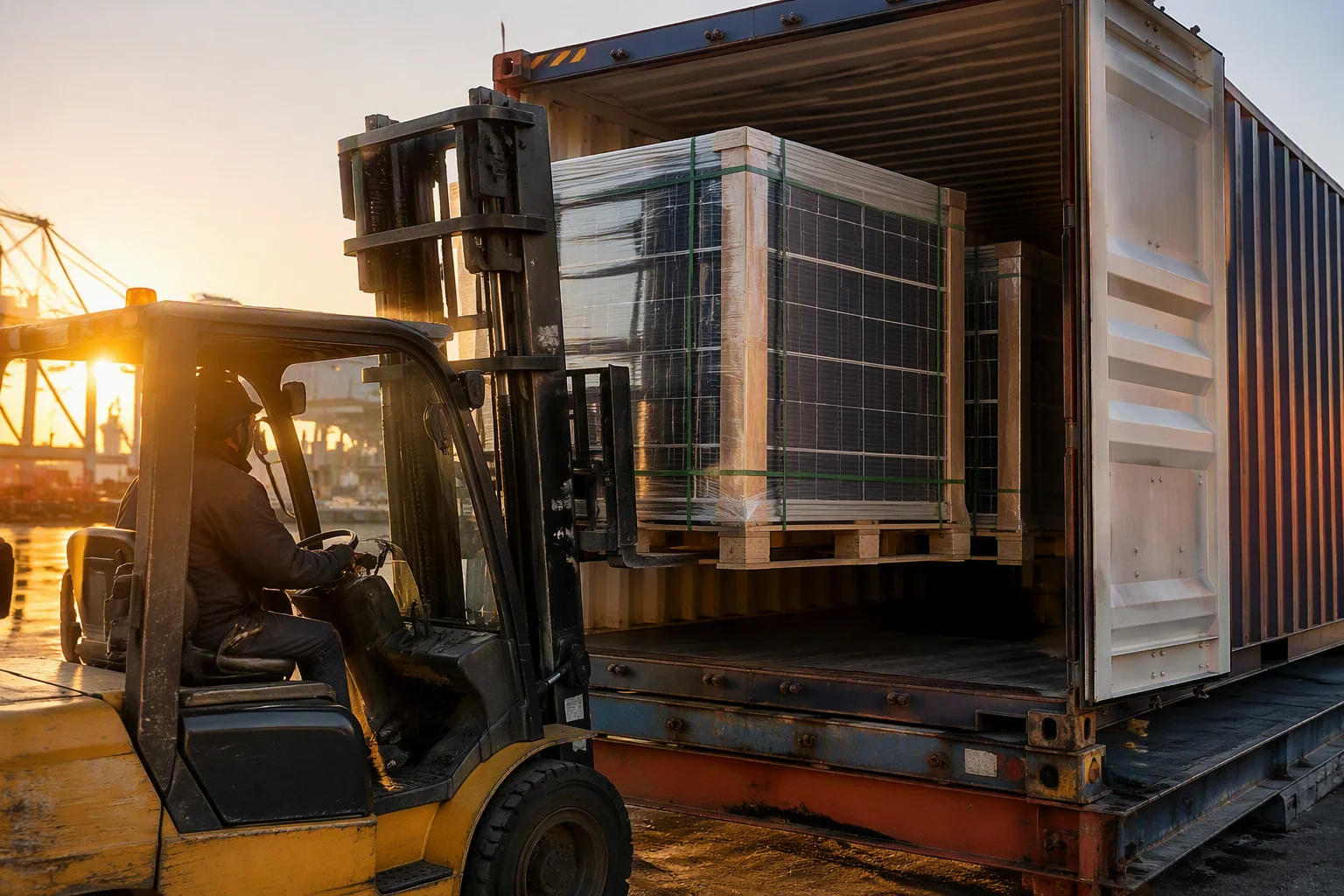
Logistics is a measurable share of landed module cost — typically several percent of the invoice — and most of it is fixed per container, not per module. Packing a few extra modules per box therefore cuts the freight cost per watt, and the reverse is equally true: a half-empty container or a badly braced one raises landed cost and damage risk at the same time. With 536 GW of modules shipped globally in 2025 and the top ten suppliers alone moving about 502 GW in 2024, ports, vessels and truck fleets are the bottleneck — the buyer who knows exact container counts books capacity instead of hoping for it.
The two cell formats, two answers
Container math starts with the module footprint. The dominant 182 half-cell format — 2278×1134 mm, or 1762×1134 mm for 54-cell rooftop modules — loads roughly 900–936 pieces into a 40'HC, the number ems-solar quotes as ~900 pcs, in 28–30 pallets of 31–33 modules each, two modules per carton. The larger 210 format, at 2172×1303 mm and up, takes about 620–680 pieces per 40'HC in 24–26 pallets, because the bigger footprint leaves less usable space on each pallet. A 40'HC measures about 12.03×2.35×2.69 m inside, and module pallets are stowed vertically — modules standing on edge — never flat-stacked.
Packaging standards that survive the sea
Export packaging follows rules that are partly commercial and partly regulatory. Pallets must be ISPM-15 heat-treated or fumigated and stamped for international wood-packing compliance — a missing stamp means the pallet can be quarantined at destination. Modules ship two per carton with corner protectors and edge guards, strapped onto the pallet with anti-slip sheets between layers. Moisture-indicator cards inside each carton give the receiver a first-pass claim record, and every pallet carries a loading photo in the container report.
Loading and transport safety
Module damage in transit is almost always a bracing failure, not a handling failure. The loading plan must include vertical stow with the pallets standing upright, blocking and bracing at the door end, and load-spreading boards so stack weight does not concentrate on pallet corners. The Tier-1 logistics playbooks — the same loading, unloading and transport-safety engineering used on major brands' shipments — specify fork-pocket positions, crane sling points and a documented five-point inspection at the factory gate. ems-solar's container report includes per-pallet photos, seal number and a tilt-record note for the haulier.
Incoterms and where the costs hide
The Incoterm decides who owns the freight risk and who pays what. Under FOB the buyer owns the cargo from the port of loading and pays ocean freight; under CIF the seller covers freight and insurance to the destination port; under DDP the seller delivers duty-paid to the buyer's door. Beyond the headline freight, watch the hidden line items: port handling, terminal handling charges, customs brokerage, and demurrage or detention if the container waits. Container math saves 2–5% on landed cost by avoiding half-empty boxes and by negotiating per-container rates with exact counts.
Planning your order around the box
Order planning runs backwards from the container. Decide the quantity, convert to full 40'HC loads using the table below, then add the timeline: 3–7 days for stock modules, 20–30 days for production orders, plus 25–35 days sea freight to European ports — longer to the US East Coast and West Africa. Because 2024–2025 shipments set records, about 502 GW from the top ten in 2024 alone, allocation is the new constraint: locking a container slot at order time beats paying spot rates at shipping time.
Loading plan per 40'HC
Six load cases with the piece counts ems-solar quotes, pallet structure and the notes that matter for customs and receiving.
| Load case | Format | Total pcs / 40'HC | Pallets | Notes |
|---|---|---|---|---|
| Standard rooftop load | 182 half-cell, 54/60-cell | ~900–936 | 28–30 | 31–33 pcs/pallet, 2 pcs/carton |
| Utility load | 182 half-cell, 66/72-cell | ~900 class | 28–30 | vertical stow, door-end bracing |
| High-power utility | 210 format, 60-cell | ~620–680 | 24–26 | larger footprint, heavier pallets |
| High-power utility | 210 format, 66/72-cell | ~620–680 | 24–26 | confirm pallet plan per series |
| Off-grid programme | 30–120 W SHS panels | ~1,500–2,000 | ~28–30 | dense carton packing |
| Mixed load | TOPCon + HJT series | per series plan | — | separate pallets per series, two datasheets |
Two rules keep a container load intact
The cross-section shows the two things that keep a container load intact. First, every pallet stands vertically — modules on edge, weight running down the frame — never flat-stacked, which forces glass to carry compressive load it was not designed for. Second, the door-end bay is braced, because that is where 30 days of vessel motion concentrates the forces. A container that opens to vertical pallets, intact bracing and dry moisture indicators arrives as a claim-free delivery; one that does not becomes a warranty dispute before the modules ever reach the rack. If you are planning a first order, send the module format and target port with your RFQ and we will return a loading plan with the piece count.
Shipping questions from buyers
Can I mix two module sizes in one container?
Yes. Mixed loads keep each series on its own pallets, and the packing list identifies series, pallet numbers and quantities so customs and the receiving team can match modules to datasheets. A common pattern is TOPCon for the volume sites and HJT for premium sites under one PO; we return a per-series loading plan with the quote.
Do I need ISPM-15 pallets for EU shipments?
Yes. ISPM-15 heat treatment or fumigation is required for wood packaging entering the EU and most other markets; the pallet must carry the treatment stamp. A missing stamp can result in quarantine or destruction at the destination port, so confirm the mark is present before loading — ems-solar ships ISPM-15 pallets as standard.
How long does sea freight take to Europe?
About 25–35 days from Chinese ports to European hubs, longer to the US East Coast and West Africa. Add 3–7 days for stock modules or 20–30 days for production orders before the vessel, and a few days of customs and delivery at the destination — DDP includes the door leg. Lock the container slot at order time; in a record-shipping market, spot capacity is expensive and late.

Send your RFQ today — spec it back in 24 hours.
Quantity, power range, destination port. MOQ from one pallet.
