
Bifacial & dual-glass yield guide
A bifacial module makes power from both faces — and the rear face is only as good as the ground beneath it. This guide maps ground albedo from 0.1 to 0.8 to real energy gain, explains why mounting height and trackers matter, and shows the payback math that tells you whether the premium is worth it.
By EMS-SOLAR Engineering · Published 15 Aug 2026 · 6 min read
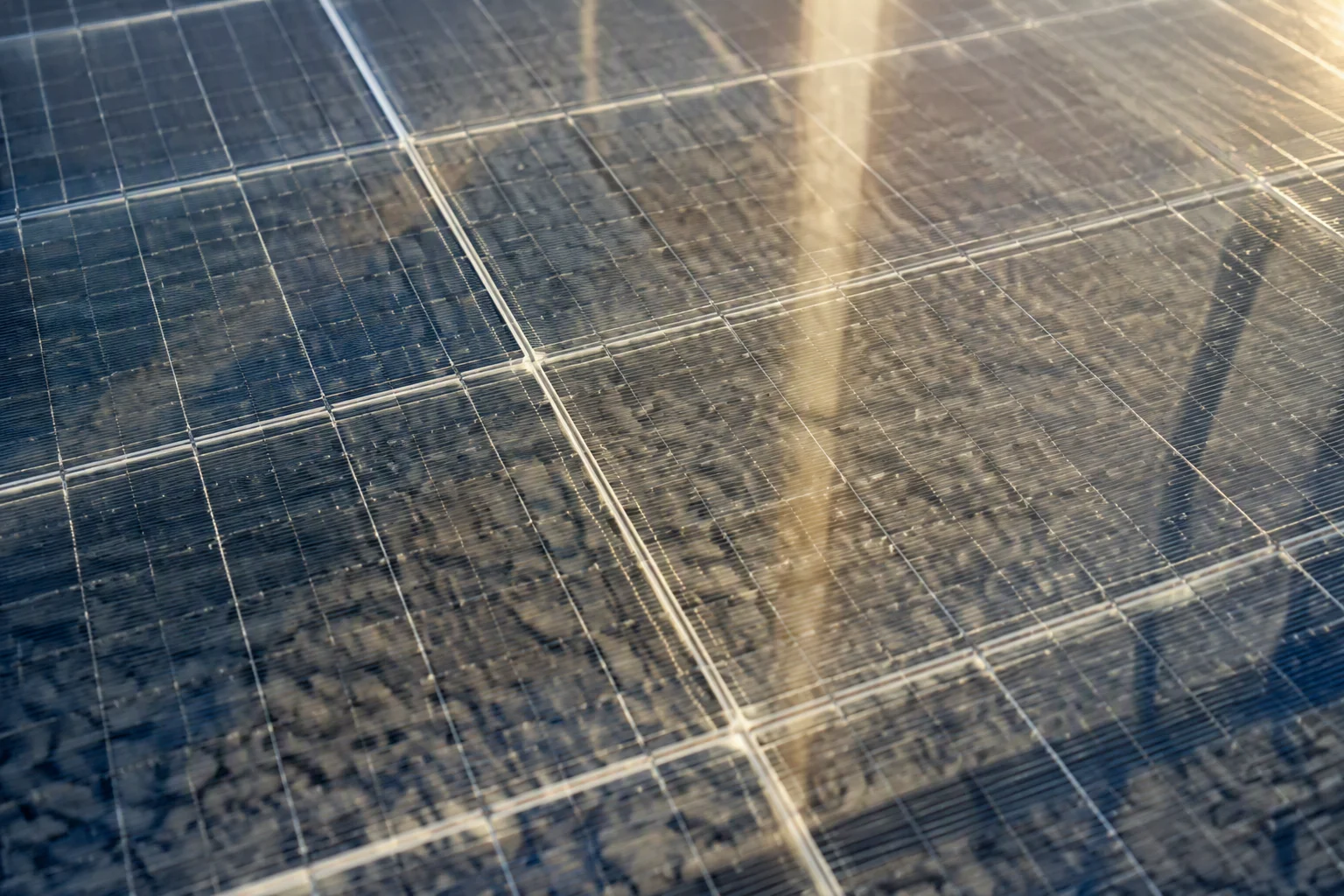
A bifacial module replaces the opaque backsheet with a second sheet of glass — 2.0+2.0 mm tempered glass on our dual-glass series — so light reflected by the ground can reach the rear cells. The datasheet figure that matters is bifaciality, rear power as a percentage of front power, which runs ≥80% on TOPCon and ≥85–90% on HJT. The rear face does not double output; it adds a slice of energy proportional to the light arriving from below. Field results cluster in the +5–30% range, with the exact number set by three variables: ground albedo, mounting geometry and module bifaciality.
Albedo: the ground decides the gain
Albedo is the share of light a surface reflects, and it ranges from about 0.05 for dark bitumen to 0.8 for fresh snow. The relationship is close to linear: at albedo 0.8 a 90%-bifacial module can add roughly 20–30% energy; at 0.2–0.25, the value of grass, the same module adds about 5–8%. White gravel and white TPO roofs sit at 0.4–0.5, worth 10–20%; concrete is 0.25–0.35, worth 8–12%. The practical rule: any surface you would describe as light-coloured earns the bifacial premium; dark soil, asphalt and bitumen roofs do not.
Mounting height and trackers unlock the rear face
Rear gain needs the reflected light to actually reach the rear cells. A module laid flat 30 cm above a dark rooftop receives almost nothing; the same module on a carport, an elevated ground mount or a single-axis tracker picks up light from a wide angle. Tracker projects, which already hold the lowest LCOE in the industry at about USD 37/MWh, are the natural home for bifacial — the rows rotate toward the sun all day, sweeping reflected light across the rear face. Elevated carport mounts add roughly +10–20% rear gain over near-ground mounting on the same surface.
Dual-glass durability: what the second sheet buys you
The dual-glass construction is not only about rear power — it is also the most robust module package available. Two 2.0 mm tempered-glass sheets resist hail, corner impacts and the microcrack progression that backsheet modules suffer after years of thermal cycling. For coastal and agricultural sites, salt-mist testing per IEC 61701 and ammonia testing per IEC 62716 are available as factory options. The trade-off is weight and cost: dual-glass modules are heavier than their backsheet siblings, which is why 2.0+2.0 mm is the standard spec and 3.2 mm is reserved for harsher sites.
The payback math
Bifacial modules carry a price premium of roughly 2.5–6% over equivalent monofacial modules, so the gain needed to recover it is small: at a 6% premium, a 7% energy gain pays for the glass in under two years. Published payback analyses put the typical recovery at about 0.74 years on high-albedo, elevated sites. The 30-year power warranty — 0.4%/yr linear degradation to 87.4% at year 30 — means every point of rear-side gain compounds for the module's full commercial life, which is why financiers underwrite bifacial tracker projects. The wider context helps: utility PV LCOE is around USD 39/MWh, trackers reach USD 37/MWh, and agrivoltaics — where raised bifacial rows generate over crops — crossed USD 5.5 billion in 2026, all segments where a few percent of extra yield is pure margin.
When not to buy bifacial
Bifacial is not a universal upgrade. On a dark bitumen rooftop with albedo 0.05–0.1, mounted 20 cm above the membrane, rear gain falls below 5% — often not enough to cover the premium. On low fixed mounts over dark soil, the same logic applies. If the site is a dark rooftop, a shaded carport deck or a fixed low rack over asphalt, spend the budget on a higher power class or an all-black aesthetic instead. The decision table below gives the thresholds.
Albedo → expected gain
Seven ground surfaces, their albedo, the gain a 90%-bifacial module can expect, and the mounting that unlocks it.
| Ground surface | Albedo | Expected gain | Best mounting |
|---|---|---|---|
| Fresh snow | 0.7–0.8 | +20–30% | tracker or elevated |
| White gravel / TPO roof | 0.4–0.5 | +10–20% | elevated ≥1 m |
| Concrete / light soil | 0.25–0.35 | +8–12% | tracker |
| Grass / vegetation | 0.2–0.25 | +5–8% | elevated or tracker |
| Dark soil / asphalt | 0.1–0.15 | +3–6% | tracker only |
| Dark bitumen rooftop | 0.05–0.1 | <5% | not recommended |
| Water | 0.06–0.1 | +2–5% | floating (verify spec) |
The gain curve has two regimes
The gain curve is nearly flat below albedo 0.2 and steepens above 0.4 — the market's +5–30% headline number is really two regimes. Below 0.2, expect 5% or less and question the premium. Between 0.4 and 0.8 the curve climbs steeply and the premium pays back quickly. When you evaluate a supplier's bifacial yield claim, ask which albedo was assumed: a +15% claim at albedo 0.5 is credible; the same claim at albedo 0.15 is not. For a ground-mount or carport project, send the site surface and mounting height with your RFQ and we will quote the expected gain with the module spec.
Bifacial buying questions
What albedo do I need to justify bifacial?
Roughly 0.25 and above. At albedo 0.2–0.25 (grass) a bifacial module adds 5–8%, which covers the 2.5–6% premium in most cases; at 0.4+ (white gravel, TPO roofs, snow) gains of 10–30% pay back the glass in under two years, and published analyses put typical recovery at about 0.74 years on high-albedo elevated sites. Below 0.2, ask the supplier to model the actual site before spending the premium.
Are dual-glass modules heavier than standard modules?
Compared with a single-glass module, a 2.0+2.0 mm dual-glass module is similar or slightly heavier in total — both glass layers are thin — and it removes the organic backsheet that degrades fastest in hot, humid climates. The stiffness of the double-glass package is actually an advantage for large-format 620–720 W modules: it reduces frame flex and allows lighter canopy and carport steelwork in some designs.
Does bifacial work on a fixed ground mount?
Yes, if the mount is elevated. A fixed mount with 1 m+ clearance over a light surface still captures meaningful rear gain; a fixed low mount over dark soil captures almost none. Trackers maximise the effect because the rear face sweeps reflected light all day. If the site is fixed and low with albedo below 0.2, monofacial is usually the better spend.

Send your RFQ today — spec it back in 24 hours.
Quantity, power range, destination port. MOQ from one pallet.
